Double Nut Locking Systems: Engineering Guide & Custom Anti-Loosening Solutions
Nov 13, 2025

In modern industrial engineering, ensuring that nuts and bolts remain secure under continuous vibration or stress is a fundamental requirement. The use of two nuts, commonly referred to as a double nut system, has long been a trusted method to prevent self-loosening and improve assembly stability.

If your projects are facing challenges with nut loosening or component instability, a comprehensive technical evaluation is critical. AYA Fasteners provides total solutions, delivering everything from optimized standard double-nut setups to bespoke anti-loosening components.
Request an Evaluation for Custom Fasteners
1. WHAT IS DOUBLE NUTS
Double nuts, often referred to as jam nuts, are a fastening system consisting of two standard nuts threaded onto a single bolt. When properly tightened, these nuts create a locking effect that prevents rotation and loosening. This configuration allows for precise torque control and increased resistance to external vibrations.
In a double-nut system, the lower nut provides the primary clamping force, while the upper nut acts as a lock to secure the position. This combination effectively resists rotational forces and is one of the oldest and most reliable anti-loosening methods.
However, it is essential to be careful while tightening the second nuts because over-tightening may cause tensile rupture and thread stripping of the bolt. Though you need a minimal investment in these nuts, you need proper skills for installation. You have to inspect these fasteners regularly and lubricate the bolted joints.
2. WHY USE DOUBLE NUTS
The main reason to use double nuts is their excellent resistance to vibration and self-loosening. When subjected to movement or dynamic loads, single nuts may gradually lose tension, leading to potential equipment failure. Double nuts counter this by creating friction between the two surfaces, ensuring a stable and reliable joint.
Additionally, this system doesn't require special tools or adhesives, making it a cost-effective and durable solution. Double nuts also allow for fine adjustments, enabling users to achieve precise torque settings without compromising security.
3. IS THE TWO-NUT SYSTEM EFFECTIVE
The two-nut system, when done properly, can be quite an effective system for eliminating self-loosening. Its success lies in the mechanical principle of 'jammed threads,' which eliminates relative motion between the nuts. This ensures a consistent preload and minimizes the risk of self-loosening, even under continuous vibration or stress.
However, correct installation is key. Over-tightening the second nut may lead to thread stripping or bolt damage. Therefore, following the recommended torque sequence is essential for long-term reliability and safety.
4. WHAT CAUSES NUTS TO SELF-LOOSEN
Self-loosening primarily occurs due to shock, vibration, or cyclic loads. These external forces cause minute rotations in fasteners that can gradually release tension. Without a proper locking mechanism, this can result in joint failure. The double-nut method directly addresses this issue by using two interacting nuts that resist rotational slippage, maintaining clamping force over time.
5. WHAT TYPES OF NUTS SHOULD YOU USE
Choosing the right type of nuts is essential for the success of a two-nut locking system. AYA Fasteners offers a complete range of nuts suitable for multi-scenario applications, especially for your two nut systems, including standard hex nuts and thin hex nuts.
Avoid using galvanized flange nuts, hexagon slotted nuts, or dome cup nuts in double-nut configurations, as they do not provide the necessary locking performance.
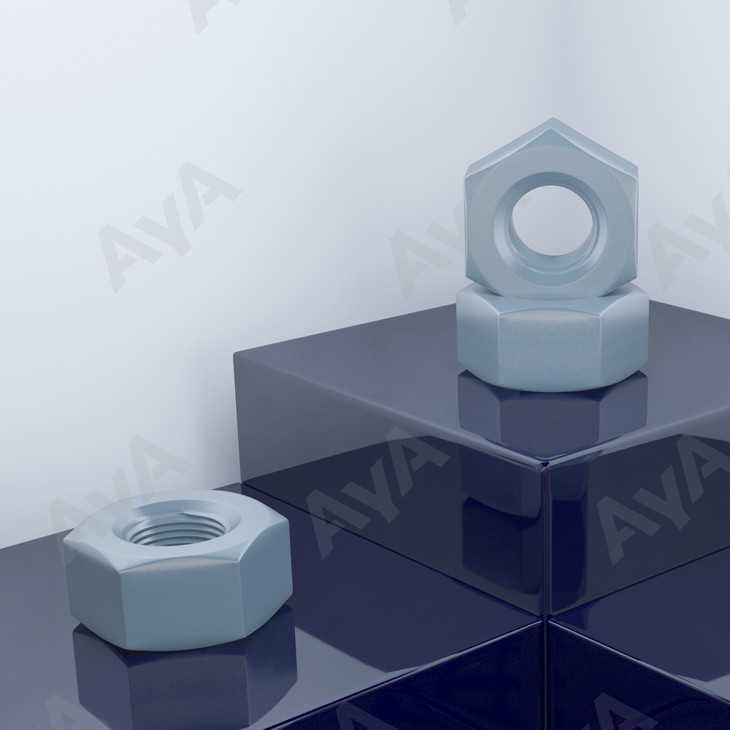
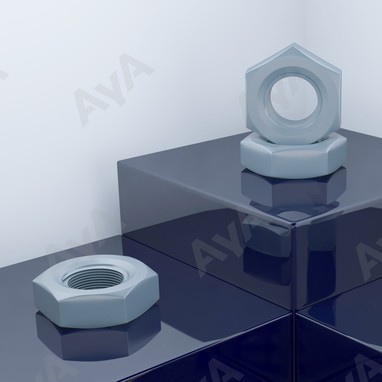

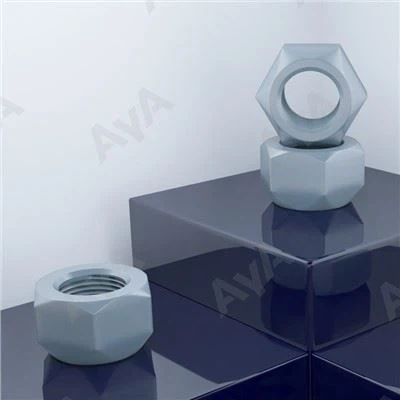
When standard profiles do not align with spatial or material requirements, applying bespoke geometries and specialized alloys is necessary. We facilitate the entire process, providing custom-machined locking nuts tailored to specialized industrial metrics.
Do you have specific procurement or customization needs for these nut types? Contact AYA Fasteners now to request a quote and technical parameters.
6. HOW TIGHTENED SHOULD THE NUTS BE
Proper tightening torque is critical for the two-nut method. Tighten the first thinner nut to approximately 25–50% of the total torque value, then apply full torque to the thicker nut. This sequence allows the thick nut to bear the majority of the load while locking the thinner nut in place. Over-tightening can lead to thread stripping or bolt deformation, so it's essential to use a torque wrench for accuracy.
7. Limitations of Standard Two-Nut Systems in Heavy Industry
While the standard double-nut method offers baseline security, off-the-shelf standard nuts often fail under the following extreme conditions:
- High-Frequency Harmonic Vibration: Standard thread tolerances allow micro-slips that lead to gradual tension loss.
- Extreme Thermal Cycling: Mismatched thermal expansion coefficients in high-temperature environments degrade the locking force.
- Strict Space Constraints: Standard heavy hex nuts require significant clearance, which is unfeasible in compact automotive or electronic assemblies.
8. Beyond Standard Configurations
While the standard double-nut configuration effectively mitigates self-loosening in general applications, sustaining preload in extreme environments, such as continuous heavy-duty cyclic loading or severe spatial constraints, demands advanced engineering.
In such demanding industrial applications, standard components may not suffice. Overcoming these specific vibrational challenges often requires tailored engineering evaluations to deliver comprehensive fastening solutions, encompassing both standard components and precision-engineered bespoke fasteners designed for exact operational parameters.
9. APPLICATIONS OF DOUBLE NUTS
Double nuts are used across a variety of industries, including marine, construction, and heavy machinery. They are ideal for applications where constant vibration, stress, or environmental exposure could otherwise cause loosening.
In the marine sector, they secure components subject to wave-induced motion. In construction, they ensure structural stability under load-bearing stress.
Is your project facing similar vibration or load challenges? Submit an inquiry today, and AYA Fasteners will design an industry-specific double nut solution for you.
10. Beyond Standard: Custom Engineered Locking Fasteners
While the standard two-nut method is effective for general use, high-stakes industries-such as automotive, solar energy, and heavy machinery-often face conditions where standard off-the-shelf fasteners fall short.
When standard components cannot meet your project's strict tolerances or environmental demands, AYA Fasteners bridges the gap between theory and production.
Our Custom Capabilities Include:
- Specialized Material Selection: High-grade alloys for offshore or chemical environments.
- Precision Thread Profiling: Custom pitches designed to maximize friction under extreme vibration.
- Space-Constrained Design: Custom-geometry nuts for compact assemblies where standard dimensions fail.
- Surface TreatmentOptimization: Specialized coatings to ensure consistent torque-tension performance.
Consult Our Engineers for a Technical Evaluation